
Places to visit in Gwalior
Gwalior is a city steeped in history, heritage, and culture. One of the top tourist destinations in Madhya Pradesh, it is also one of India's most important heritage destinations. Step into Gwalior, and you'll feel as though time has stood still, surrounded by magnificent architecture and fascinating stories from the past.
The city boasts a glorious history dating back to the 8th century AD. Over the centuries, it has been ruled by many dynasties, each leaving behind a rich cultural legacy. Among its many historic landmarks, the magnificent Gwalior Fort stands out. Described as the "Pearl among Fortresses in India," the fort has witnessed the rise and fall of several powerful northern Indian kingdoms.
Renowned for its ancient temples, grand palaces, and impressive monuments, Gwalior is often regarded as the cultural capital of Madhya Pradesh. It is also famous as the birthplace of the legendary musician Tansen. During British rule, Gwalior was one of the prestigious princely states entitled to a 21-gun salute. Popular attractions include Gwalior Fort, Jai Vilas Palace, Teli Ka Mandir, Sun Temple, Gujari Mahal, Sas Bahu Temple, and Man Mandir Palace.
Gwalior is also an important educational hub, home to the prestigious Scindia School, established in 1897 within the Gwalior Fort. Today, it is recognized as one of India's leading boarding schools.
The city comes alive during the famous Tansen Music Festival, a five-day celebration held in November or December to honor the legendary musician while promoting emerging talent. Other major festivals include Rang Panchami, Navratri, Bhavbhuti Samaroh, Baba Hira Bhumia Fair, Ramleela Festival, and the Gwalior International Trade Fair, all celebrated with great enthusiasm.
With its rich history, architectural marvels, vibrant festivals, and cultural heritage, Gwalior holds a prominent place on India's tourism map, offering visitors an unforgettable travel experience.
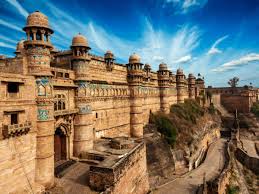
Gwalior Fort
Gwalior Fort is a hill fort near Gwalior, Madhya Pradesh, India. The fort has existed at least since the 10th century, and the inscriptions and monuments found within what is now the fort campus indicate that it may have existed as early as the beginning of the 6th century. The fort has been controlled by a number of different rulers in its history. The present-day fort consists of a defensive structure and two main palaces, Gujari Mahal and Man Mandir, built by Man Singh Tomar. The Gujari Mahal palace was built for Queen Mrignayani. It is now an archaeological museum. The second oldest record of "zero" in the world was found in a small temple, which is located on the way to the top.
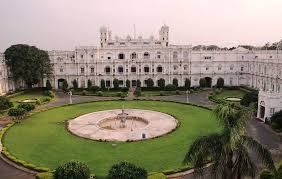
Jai Vilas Palace
The Jai Vilas Mahal, also known as the Jai Vilas Palace, is a nineteenth century palace in Gwalior, India. It was established in 1874 by Maharajadhiraj Shrimant Jayajirao Scindia Alijah Bahadur, the Maharaja of Gwalior. While the major part of the palace is now the "Jiwajirao Scindia Museum" opened to the public in 1964, a part of it is still the residence of his descendants the former royal Maratha Scindia dynasty. It is a fine example of European architecture, designed and built by Sir Michael Filose. A combination of architectural styles, the first storey is Tuscan, the second Italian-Doric and the third Corinthian. The area of the Jai Vilas palace is 1,240,771 square feet and it is particularly famous for its large Durbar Hall. The interior of the Durbar Hall is decorated with gilt and gold furnishings and adorned with a huge carpet and gigantic chandeliers. It is 100 feet long, 50 feet wide and 41 feet in height. The palace was described by Sir William Howard Russell in 1877 The Palace covers an area of 124,771 square feet, exclusive of the inner square, which is 321 by 321% feet. The building is double-storied, and the wings and turrets are three- and five-storied
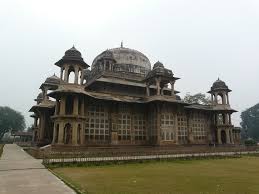
Tomb of Tansen
Tomb of Tansen is Historic memorial of a famous musician.
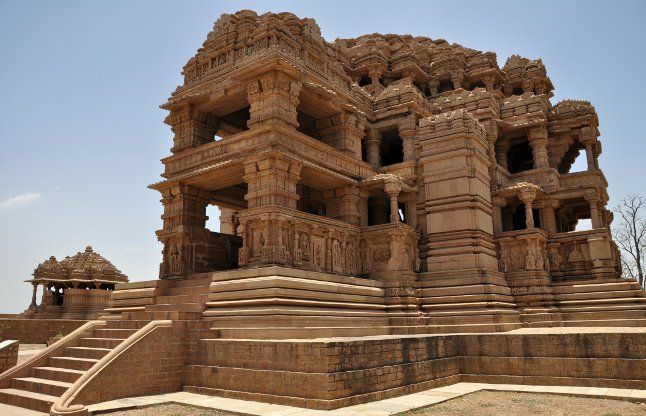
Sas Bahu Temple
Sasbahu Temple, also called the Sas-Bahu Mandir, Sas-Bahu Temples, Sahastrabahu Temple or Harisadanam temple, is an 11th-century twin temple in Gwalior, Madhya Pradesh, India. Near the Gwalior Fort and dedicated to Vishnu in his Padmanabha form, like most Hindu and Jain temples in this region, it is mostly in ruins and was badly damaged from numerous invasions and Hindu-Muslim wars in the region. It was built in 1093 by King Mahipala of the Kachchhapaghata dynasty, according to an inscription found in the larger of the twin temple. The twin temples are situated in the Gwalior Fort. The temple's tower and sanctum has been destroyed, but its architecture and damaged carvings can still be appreciated from the ruins. The jagati platform is 100 feet long and 63 feet wide, on a square plan. The temple was three-storeyed, which was one of its distinguishing features and sophistication